Friday, 16 April 2010

Goudougoudou

Haitians have come up with a new word for 'earthquake'.

Goudougoudou they say, which to me seems to capture both the infernal noise of crumbling buildings and that something is chasing after you. It certainly takes some of the clinical menace away from words like “seismic” and “tectonic plates” and almost turns it into some sort of yeti or some other lumbering rough beast, slouching towards you. I inquire about the word in Camp Obama on the Northern outskirts of Port-au-Prince, where I have gone to visit on an afternoon outing. SOS Children's Villages does not have any activities here, but I have passed the camp in a car enough times to be curious about what life is like here.

Goudougoudou I just say and all five young adults sitting on the wood plank bench laugh out loud of my knowledge of the word - or was it my pronunciation?

It is good to hear laughter here, amongst cardboard covered homes and bare feet children. Camp Obama is an extremely destitute place on the foot of a mountain slope where 4000 people have set up home after the quake. There is little sign of international aid, normally visible on the logo-imprinted tents or in the form of food aid packages littering the ground.
There are no 'child-friendly spaces, no schools, and no clinics with banners from medical aid organizations or water in tanks. A row of five toilets in solid plywood looks too well constructed to not be a donation, but that is all I manage to come across during my walk around. A small truck with canned food arrives and people immediately form a queue. It is not a formalized food distribution with coupons and aid workers managing the process and again, there are no logos. Where the food comes from no one really tells me.

'Life here is terrible' says a 17-year old girl who has taken it upon herself to show me around. Her name is Lovely and that is what she is indeed. Still, at the background of all this destitution, boys are flying kites and men and women say 'bon soir' in a polite manner. For better and worse the place actually has a homely feel.

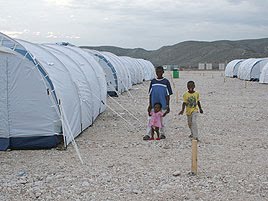
Homely is a word that does not describe the other camp I saw that afternoon. Placed outside of town in a moon-like landscape of bare mountains, rocks and same-shaped bubble tents, the UN and Haitian authorities have established a new site and begun moving some of the most vulnerable inhabitants from the overcrowded Petionville Golf Club settlement into mid-town. In the first few busloads, many families with children were moved. I am happy to see that they all wear bracelets, because it is a well-established fact that children are often at risk of being separated form their families in the normal chaos that accompanies such events. With no colors, nothing but straight lines and many men in uniform - there to provide security from surrounding mountain side camps such as the Obama Camp inhabitants who have not received much - it is hard to imagine a more child un-friendly environment. Hopefully that will get priority too, as it becomes a more established camp.

I understand the urgency behind the movement. It is raining almost every evening now and as I am writing this, a rhythmic drumming of drops on roof accompany my typing. I try to imagine the conditions in which young Lovely will be tugging herself in. I also think about the 8-month pregnant woman in Camp Obama, whose husband had died during the quake. Her belly button was poking out from a big bump and her camp shelter barely big enough for her to lye fully stretched - not on the bed because there was none - but on the ground.

As sterile as white bubble tents on a row might look, it still keep you dry at night.

Back to School

The calendar said late February and I had been in and out of that particular classroom many times, before I noticed that the date of the earthquake was still written on top of the blackboard. It was partly covered behind a tall pile of kidney beans in boxes.

'12 January' it said in white chalk. In the right hand top corner a small matrix showed the roll call: 2 absent boys and 43 present boys and girls. "I wonder how many of them will return to this school - if ever - and when?" I thought to myself. That answer came Monday when the SOS Hermann Gmeiner School in Santo reopened.

In fact, it has been just a few days since most classrooms contained boxes with food donations and medical supplies.

Following the earthquake and the massive destruction of education facilities, classes were suspended on a national level and the SOS school was used as storage facility and office for the emergency relief programme of SOS Children's Villages.

When I saw the two lines of students filing up in the courtyard shortly before 7am I felt we were passing an important milestone on the road to recovery. School is back in. Life is starting again and is hopefully going to give children and parents a feeling of normality and security.

After observing a minute of silence in memory of those who perished during the earthquake, school principal Myrtil Jean welcomed all returning and new pupils.

"Education is an obligation and a chance you get - so take it and work hard," he advised.

"Class 9 is now in this room, class 6 in that one," he then said and pointed to the very room where I had seen the date of the earthquake on the blackboard. I followed the students inside and was pleased to see the change in date. But I was even more pleased when I saw the roll call with the headcount: no absentees.

Thursday, 1 April 2010

"Most cases are not this easy"

Line Wolf Nielsen, currently in Haiti for SOS Children's Villages, experiences the reality of family reunification.

A week after Haiti's devastating earthquake, Phillippe Onecio admitted her youngest child to the SOS Children's Village in Santo. With six children to care for and an absent husband, she thought it best to give up her youngest child.

As the Media Coordinator in the Santo children's village, I often get questions from visiting journalists about this culture of 'giving up your child'. It's a question that requires a non-judgmental answer and to better understand I ask myself what I would do, if I found myself living in a shattered country, with a destroyed home and no hope for a better future. To the journalists I say that a destitute family background is the story for many a child currently in the care of SOS Children's Villages in Haiti and I inform them that if it is at all possible, SOS will see to it that the child can return to live with its family.

But what if the parent truly believes the child is better of with SOS Children's Villages?

A few days ago I spent the day with SOS social worker Rosita Declama and got a first hand impression of all the work that goes before a so-called family reunification.

"Do you want your child to be with you?" Rosita asks Phillippe Onecio as they sit outside the cracked wall of what used to be the family house. "My home feels empty and I would like to have her come live with me again." Despite having given her up at an earlier stage, Phillippe now believes that her 3-year old daughter belongs at home. The mother sells soap in the market, but there are days with few or no customers. Rosita notes that 'the economic situation of the family is un-stable'. But she also writes that she recommends a family reunification 'without any reservations'. The mother wants her daughter home.

"Most cases are not this easy," Rosita tells me - A statement illustrated later in the afternoon, when we talk to a single father of two, a boy of 8 and a girl of 6 years, both currently living in the SOS village. "I love my children but I am not capable of caring well for them at the moment. I have no work and look at where I live," he says and points to the sheets above his head, his only cover. Two grandparents died during the quake and the father is the only relative the children have left.I know that in Haiti poverty, lack of shelter and single parenthood is rampant - and was so also before the quake. Still, to me it does not exactly look like an ideal situation to return the children to.

As we walk back home Rosita explains: "SOS is focusing on children fully orphaned or completely abandoned. If the children still have family or relatives willing to care for them, we can see if we can help. But we are not going to admit children for long-term care in the SOS village if they have a parent left who is capable." I am well aware of this, but I am hit by the urgent need to not only deal with the symptoms but also to look into root causes of child abandonment.

The next day she meets the two children in their SOS home and chats with them. They don't want to leave, the older boy says. "Its not going to be easy, but they will have to return home to their father soon," Rosita sighs. I feel like questioning her on why she thinks it is the right decision, but I cut myself short. I know the answer already. I can hear an echo of myself from when I talk to journalists: "Children really should be with their family and the big task for Haitian authorities and organizations such as SOS Children's Villages is to find ways to support such vulnerable families," I would say. I know the values behind such statements and I can communicate them effectively because I also truly believe it is right. But as with many values and policies, it's good to have a reality check once in a while.

I must not forget to tell that Phillippe did come the day after to take her little girl home. She had even put on a beautiful hat for the occasion. "It is not easy to say goodbye and my daughter looks sad about having to leave - which I can understand," Phillippe tells me as I try to get the girl to smile for the camera.

Once the paper work is done, Rosita walks the two of them to the gates. I note that the girl has not lost trust in her mother and reaches for her hand as they walk out. Then we all wave and I know that this was one case closed as it was supposed to be closed.

Monday, 29 March 2010

Haiti has changed me

Louis Klamroth, in Haiti for SOS Children's Villages, says goodbye to Haiti and looks back on two of the most beautiful, terrible months of his life.

My last "official act" was to request an escort from the UN for one of our food distributions. Last week a mob seized one of our trucks and stole all the rations in it. For a long time, there was no need for escorts, but it looks like we will be distributing our food donations only when there is military personnel protecting us, even though I just can't get used to the thought of it.

Everything is ready. My successor has started her work and for me, the time has come to say goodbye to Haiti. The last two months have been the most beautiful, terrible, and intense thing I have ever experienced in my life. I admit I am exhausted and also ready to leave now. My time here in Haiti has demanded every last bit of energy of me and I look forward to being on my way to Santo Domingo tomorrow.

Many things I have seen here will stay with me for a long time. Haiti has changed me. I have had so many moments of joy here that this blog would exceed its limit were I to recount them all here. Today I took Marevie into my arms once more. To think I may never see her again makes me feel physically ill. The doctors have promised to take very good care of her and to send me an update on how she is doing via email. Leonie, the SOS-nurse, has also promised to be in touch regularly. The children in the SOS Children's Village of Santo have worked their way into my heart, and even though we only ever communicated by using our hands andf feet, I have had the privilege of being taught a lot by them.

Even if it'll be a while before I can process some of my experiences here, I leave with a feeling of accomplishment. We have made an incredible amount of progress (although it does feel a bit like we've barely scratched the surface of the problem); and the team of SOS co-workers is well under way to securing a safe, enduring and prosperous future for many of Haiti's children. I am proud to have been a part of this team and thank all those who remain on it, not just the people working for SOS Children's Villages here in Haiti, but also those all over the world; for making it possible for us to return to the children that most valuable posession so many of them had almost lost: their childhood.

Monday, 22 March 2010

Emil

Emil doesn't let go for a long while. He has just seen his mother again for the first time in a month. His mother is laughing while tears run down her cheeks, and Bairon and myself feel a bit out of place. Bairon is from Guatemala and will be leading the temporary care programme here at the SOS Children's Village in Santo for two months. He has quite a workload to take care of, since he is in charge both of the new arrivals due to be admitted to the temporary care programme, and of the family reunification programme. During the last few weeks, 80 families have been reunited, 120 more are scheduled to be reunited in the next week. But back to Emil. Emil arrived in the SOS Children's Village two days after I did [in February, editor's note], his father died when their house collapsed. Emil's mother brought him to us, since she couldn't take care of him. In cases like Emil's, an entry is made at registration to signal that the parents are receiving help so that the children can return to live with their parents after a certain time.

During the first few days, Emil was having a hard time, he cried a lot and wanted to be allowed to go see his mother and father. But the other children in his SOS family and of course his SOS mother took good care of him. So good, in fact, that the last time I saw him about two weeks ago, he was captain of the football team and had just scored two goals. I couldn't believe this was the same boy who refused to let go of his mother, crying inconsolably. He had become fully integrated into the village and had made many friends. As I watched him, he was duly celebrated by his teammates, shot a fast ball in my direction and said "Louis, my mother is coming tomorrow to take me home. Do you think I'll be allowed to come back to visit my friends here?" After I assured him that would be possible he breathed a sigh of relief and ran back onto the pitch.

So yesterday was the day the families were reunited. Emil's mother, grandmother and an aunt had come to take him home. As soon as he saw his mother, he dashed over and hugged her really tightly. For a few minutes, he wouldn't let go; and it was an intimate moment, a beautiful moment, and Bairon and myself were unable to fight back a few tears. Slowly, Emil let go of his mother, turned to me and, in a voice sounding a lot more mature than his ten years of age, said "and now, it's time to say goodbye". He walked over to me and Bairon and coolly low-fived us both, but I could tell how nervous he really was. Even before she took him into her arms, his mother was already crying. She whispered something into his ears and walked him to the gates of the village. Emils friends sang a Haitian song and waved to him. In the weeks to come, the social workers will be visiting his family frequently to provide them with food and tents, if necessary. It isn't the last time Emil sees the SOS Children's Village. I am certain he'll be back to play some more football with his new-found friends. Absolutely certain.

Wednesday, 17 March 2010

A few moments of bliss

Marie-Ange laughs out loud, flashes one of her beautiful smiles, and I can't help but smile back. "Louis, you ask too many questions, just finish your mango!" Marie-Ange is sixteen, just like her sister Ange-Marie and her brother Jean. They're triplets. "Your hair is just no good for dreadlocks, Louis", she says and starts laughing again. There's a gleam in her eyes that makes me forget the terrible things we were talking about just moments ago. "What are you doing here already" asks Ange-Marie, who is just coming in through the door, "food won't be ready until half past six". She's right: I had come a bit earlier, to learn more about their work. "Just a minute there, Louis", says Ange-Marie, "don't call it work. It's my passion!" This passion Ange-Marie is talking about is her work with the children in the village.

Every Friday, a group of seven teenagers meets with the five psychologists working in the village. They discuss the schedule for the coming week and sum up the preceding one. Every day, from 9:00 AM to 1:00 PM and again from 2:00 to 4:00 PM, the seven girls organise activities for the 5- to 13-year-olds in the SOS Children's Village in Santo. Marie-Ange and Ange-Marie are two of them. The mornings are spent drawing, writing or singing, and the afternoons are used to create and rehearse dance routines. Their programmes are developed together with the psychologists, each of them takes care of 30 children. Asked why they do it, they tell the story of one of their brothers, who lived outside the village and died of his injuries the day after the earthquake. "Even if none of the houses here in the SOS village collapsed, we can still relate to what many of these children have been through. Spending time with my friends and keeping ourselves busy helps us take our mind off things, and that's exactly what we want to do for these children".

Marie-Ange starts to dance to the song her sister has started singing, and even though my hips are having trouble finding the right rhythm, for just a moment, I feel relieved of all burdens. We keep on dancing for a few minutes, and Marie-Ange tells me that this is exactly what they do with the children - help them forget for a few happy hours, just let them have fun and allow them to stop thinking about anything. What these two girls are doing here is a great help, and they do it gladly for others in spite of what they have been put through themselves. I obviously have a lot to learn from these two.

Monday, 8 March 2010

Wake-up calls from the rooster

It's still dark at six o'clock in the morning, but the rooster has crowed for the fifth time already, so I peel myself out of the bed, pour a bowl of water over my head and start walking towards the office. I quickly scan the fifty-odd emails, all either updates from UN cluster meetings or requests from other NGOs and join Carlos, the head of the emergency relief team, to discuss the relevant issues of the day. After that I make sure the newly arrived SOS co-workers from other countries have everything they need. Then I head out to the UN airport, where many UN bodies have set up their headquarters. One of them is the Logistics Cluster, relevant to me because of the tranports I have to organise frequently. I speak about the emergency relief goods stocked in the warehouse of the WFP to Cristophe, a Frenchman, and Mike, from Britain. The World Food Programme lends us two trucks to transfer the goods (today, it's 5,000 sleeping bags) to the village. From the airport I drive back to the village, which can take anywhere between 15 minutes and an hour, depending on traffic conditions. In the meantime, my colleagues from German Help have contacted us and confirmed they would fly in 600 kilos of noodles as well as four members of a Spanish foundation by helicopter.

As I bring Gustavo the 5,000 sleeping bags and huge amounts of food, he sighs in exhaustion. Gustavo is in charge of stocking the goods, and he is using the school building for storage, since we don't have an actual warehouse and there never seems to be enough space. Despite the difficulties, we find a solution for the storage of the goods and I tell him when the trucks will be arriving. I head back to the airport and into the warehouse, where I am loudly and cheerfully greeted by the 50 Haitian workers there. I show them the goods that need to be loaded onto the trucks, then drive back to the village ahead of the truck drivers, to make sure they find it.

We get to the village right on time, the helicopter is just landing and I just barely make it over to greet our guests. After a tour of the village and a brief conversation, they promise to supply us with medicine and food. I am relieved, but don't have time to dwell on these good news, since it's 06:00 PM and I need to get back to the airport as soon as possible, in fact, I'm late already. Frantically, I try to get a car, but they're all out at the community centres. But I'm in luck: it turns out the helicopter has to return to the airport for fuel and the pilot offers me a ride. Once there, I talk to Veronica (somehow everyone seems to be on first-name terms), who is in charge of the Food Cluster: We discuss how we might be included in the planned UN programme "Food for Schoolchildren", but we disagree on details, so she offers me 15 tons of army food for the meantime. I guide the drivers through the traffic again, which this time includes five cows who refuse to leave their position in the middle of the road, which means it's 8 PM by the time we get back to the village. The teenagers of the village lend us a hand unloading the goods and the trucks are empty in no time flat. I haven't eaten all day, so I devour the army rations in seconds and go to join the day's final meeting. Carlos thanks us all for our commitment and dismisses us with a few rallying calls. Back in the office we write a budget plan for the donations of the Spaniards. It's midnight now, I've finished my blog entry and it's time to go to bed - the cock will be up well before me again.