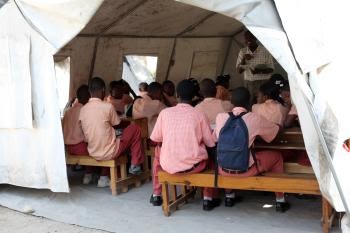
SOS Children’s Villages Haiti contracted the faculty of education studies of local Quisqueya University to give teachers further training and renew the curriculum. The teachers’ training enters phase II as 66 Haitian teachers receive classes in August 2011.
Most Haitian newspapers are written in French. An estimated 95 percent of the Haitian population are not proficient in French. An estimated 51 percent are not able to read at all.
The Haitian educational system has added to existing social inequalities over the past decades. As part of the emergency work after the earthquake in 2010, SOS Children‘s Villages decided to focus on the field of education in order to be able to provide sustainable contributions to the process of change.
A typical lesson in Haiti is a one-way street: the children simply echo what the teacher says. In order to learn about the student’s needs and teach them to have their own ideas, to think themselves and decide independently, this system must change. Of course, this has to be done step by step and starts with the training of teachers.
On Monday 1 August, the second phase of the teachers’ training started in Quisqueya University in Port-au-Prince. Forty-two professors of the SOS Hermann Gmeiner school participated in the intense summer programme provided by the faculty of education studies of the well-established university. Two weeks later, on 15 August, the course started for 44 teachers in Cap Haitien. The teachers receive a total of 60 hours of free training and a certificate of participation.
Francis Faroutine, national coordinator for education with SOS Children’s Villages Haiti, on the first impact of the classes: “The presentations are good and the facilitators from Quisiqueya University do a good job. Even though this phase of the training is quite intense for our teachers, they are motivated and participate actively”.
At the official inauguration of the teachers’ training phase II, co-workers from different working areas of SOS Children‘s Villages in Haiti were present. Ilu Valenzuela, from the international support team of SOS Children‘s Villages Haiti, says: “We want a school with quality: human quality, technical quality and professional quality”.She believes that education will enable the children to become independent and self-confident and that it is important to pay attention to the needs and rights of the children. A remarkable detail is that she gave her inauguration speech in Haitian Creole, which by now is spoken - at least on a basic level - by every member of the international team.
1620 students visited classes in the SOS Hermann Gmeiner Schools in Santo and Cap Haitien past school year, and there may be up to 2119 in coming year. This increase is related to current construction works: a second school is being built in Santo, which is scheduled to open its doors to new students at beginning of 2012.
In fact, the actual contract with Quisqueya University over the intensive course for teachers as well as a renewal of the curriculum, is already the second phase of the teachers’ training programme in Haiti. It is based on the previous work of Bettina Reiter, a voluntary from Austria. A team of international and national co-workers of SOS Children‘s Villages Haiti had analysed the current situation and teaching methodologies in the SOS Hermann Gmeiner school in Santo and Bettina Reiter developed a plan for teacher training. Following this plan, she provided classes and work sessions from March to June 2011. Before the end of her stay in Haiti, she took part in the negotiations with Quisqueya University, during which a follow-up plan for the training was set up.
The third phase, which is to start in 2012, will be a permanent training centre for teachers in Santo. In an interview in January 2011, Heinrich Mueller, deputy secretary general and continental director for Latin America and the Caribbean, points out the importance of a more individual form of education: “Each child has a certain level of development and the teachers should find out at which level they are. Based on that, they should provide individual support to each student, according to his or her education and development”.
Haiti has a long way to go until every child attends a school and the majority of the population is able to read the newspaper. SOS Children’s Villages was searching for ways to create a more permanent impact than just building new schools. The teachers’ training is meant to open up new aspects and perspectives; first to teachers and through them to the students. After all, as Henry Brooks Adams once put it: "A teacher affects eternity; he can never tell where his influence stops."
Wednesday, 24 August 2011
Thursday, 18 August 2011
Coming back to Haiti, coming back to life
After a long intermission we declare this Blog „alive“ again. The first impressions after coming back to Haiti...
I have been out of Haiti for more than five weeks and it felt good to arrive at Toussaint Louverture International Airport in Port-au-Prince again. Upper-class Haitians in exclusive outfits, international helpers in functional wear and missionaries in mission-shirts searching for their bags in a lively, loud and chaotic atmosphere. I have seen the procedure before, and was not as surprised as in November 2010 when I arrived here for the first time.
Three hours later, in estimated 40 degrees Celsius (I was coming from Austria, where I woke up with 13 degrees the day before), trying to clean my room from an incredibly resistant layer of dust, the joy of being back felt somehow lessened.
Only a few days later we heard that tropical storm Emily was moving straight towards Port-au-Prince. Necessary measures were taken, children who lived in the temporary shelters moved to the school for two nights. Strong winds cooled the air down and all bureaucratic procedures were in pause, once again. In the end Emily changed direction and all the area of Port-au-Prince, where thousands still live in tents and temporary shelters, was much less affected than predicted.
Now, some days have passed by and I‘m getting back to routine. Some things have changed, other‘s did not. School is on holidays, for instance, and there are less children around than usually. But it‘s still hot, as I mentioned, and things are still more complicated than you‘d expect them to be.
What I wanted to say to the readers: this blog may be presumed dead, but it will come back to life. In Haiti, the home of zombies, we are in the right place for resurrection, I suppose.
I have been out of Haiti for more than five weeks and it felt good to arrive at Toussaint Louverture International Airport in Port-au-Prince again. Upper-class Haitians in exclusive outfits, international helpers in functional wear and missionaries in mission-shirts searching for their bags in a lively, loud and chaotic atmosphere. I have seen the procedure before, and was not as surprised as in November 2010 when I arrived here for the first time.
![]() |
| An incredibly resistant layer of dust seemed to find it‘s way directly from my room into my lungs. |
Three hours later, in estimated 40 degrees Celsius (I was coming from Austria, where I woke up with 13 degrees the day before), trying to clean my room from an incredibly resistant layer of dust, the joy of being back felt somehow lessened.
Only a few days later we heard that tropical storm Emily was moving straight towards Port-au-Prince. Necessary measures were taken, children who lived in the temporary shelters moved to the school for two nights. Strong winds cooled the air down and all bureaucratic procedures were in pause, once again. In the end Emily changed direction and all the area of Port-au-Prince, where thousands still live in tents and temporary shelters, was much less affected than predicted.
![]() |
SOS children currently living in the temporary shelters were moved to the school with their families, as Emily was predicted to affect the zone of Port-au-Prince. |
Now, some days have passed by and I‘m getting back to routine. Some things have changed, other‘s did not. School is on holidays, for instance, and there are less children around than usually. But it‘s still hot, as I mentioned, and things are still more complicated than you‘d expect them to be.
![]() |
| Some things changed during the past weeks, others did not: Hermann Gmeiner school is on holidays, but the social centre is still open. |
Wednesday, 15 June 2011
A whole new world of complications
![]() |
| The new temporary offices for the national office and international team of SOS Children's Villages Haiti - Photo: S. Preisch |
![]() |
| Even though the old colonial building that housed the national office until the earthquake did not collapse, it was deemed dangerous to work in - Photo: H. Atkins |
Building a new national office will take a while - of course, with all the other constructions necessary in Haiti, this is not the first priority. So the gradually growing team of the national office had to find a temporary solution. The containers seemed to be the best and easiest way to provide a working space for everyone in the team.
![]() |
| Discussing, relocating, taking measure: a lot of people on a little space during the first few days in the containers. |
![]() |
| Time and again, delivery of the containers was delayed until people began to think they didn't exist. - Photo: S. Preisch |
I had first been told about those containers that would be arriving soon upon my arrival in Santo in mid-November 2010. Ever since then, this „soon“ was repeated over and over again until we all thought the containers were a myth. Some classrooms in the school had been turned into offices, as well as one building of the housing area for the international staff and basically every terrace and living room.
![]() |
| The new office spaces are cramped, but are a significant improvement on work conditions up to now. - Photo: Sophie Preisch |
We are used to complications, but we‘re just getting used to new dimensions of it. „I am contented. I mean: yes, it is a small space, yes, we still have problems with electricity and the network. But at least the containers are finally here and we were able to move our offices, after so much effort“, Freinet says.
Friday, 20 May 2011
Goodbye José
José Muñoz, volunteer for America Solidaria assigned to SOS Children‘s Villages Haiti, passed away on Thursday 19 May at the age of 28. Thank you José, for dedicating five precious weeks of your short lifetime to us and to Haiti’s children.
José laughed a lot. I remember him laughing joyfully. He used to sit down to eat with us and say something that made us all laugh. But he was never laughed about the failures or shortcomings of others, his laugh had nothing cynical or hysterical. He just made the world a little happier. José was able to listen, he was able to see and he was very aware of problems and social injustices in our world, but he still had the energy - and desire - to laugh.
José came to the SOS Children’s Village in Santo on 11 April of this year as a social worker, together with his colleague Belén, a doctor. Both were from Chile, both were sent by “America Solidaria“, both volunteering in Haiti. Just five weeks after their arrival José passed away. The 28-year-old suffered a cardiac arrest on during the late morning of 19 May. Our co-workers, and especially his good friend Belén - the only doctor in the village - reacted quickly, gave him first aid and did everything in their power to get him to the hospital and save his life - but José didn’t stay.
All of us at SOS Children‘s Villages Haiti want to extend our deepest condolences to José‘s family, whom he loved very much. To his mother and his sisters, with whom he grew up and who played a big part in the development of José‘s compassionate and gentle character. To his father, who proudly told everyone he knew about his son’s decision to work in Haiti - which José, in turn, told us brimming with pride. To all his relatives and friends who said goodbye to José in March, fully expecting to see him again after his year of voluntary work in Haiti.
The dead live forever in Haiti, a woman once said to me. It seems José decided to immortalize himself and came to Haiti to die. We‘re grateful that he passed by here in Santo before passing away for good. He certainly left something immortal behind with us.
We see him laughing.
![]() |
A truly gentle man with a truly gentle smile we will all miss: José. The picture was taken at his induction to the organisation „America Solidara“. |
José came to the SOS Children’s Village in Santo on 11 April of this year as a social worker, together with his colleague Belén, a doctor. Both were from Chile, both were sent by “America Solidaria“, both volunteering in Haiti. Just five weeks after their arrival José passed away. The 28-year-old suffered a cardiac arrest on during the late morning of 19 May. Our co-workers, and especially his good friend Belén - the only doctor in the village - reacted quickly, gave him first aid and did everything in their power to get him to the hospital and save his life - but José didn’t stay.
All of us at SOS Children‘s Villages Haiti want to extend our deepest condolences to José‘s family, whom he loved very much. To his mother and his sisters, with whom he grew up and who played a big part in the development of José‘s compassionate and gentle character. To his father, who proudly told everyone he knew about his son’s decision to work in Haiti - which José, in turn, told us brimming with pride. To all his relatives and friends who said goodbye to José in March, fully expecting to see him again after his year of voluntary work in Haiti.
The dead live forever in Haiti, a woman once said to me. It seems José decided to immortalize himself and came to Haiti to die. We‘re grateful that he passed by here in Santo before passing away for good. He certainly left something immortal behind with us.
We see him laughing.
![]() |
José (bottom row, second from right) participated joyfully in all kinds of events and gatherings. On Monday, 16 May, he played in an international soccer match at the SOS Children‘s Village. |
Thursday, 21 April 2011
The Rain and the President
A new season is starting in Haiti - and with it, a new period of governance. Tèt kale, as Michel Martelly is nicknamed in his homeland, faces great expectations.
On our way to Delmas, Port-au-Prince, I see new tents in the camp we are passing. Is it so much easier to import and set up new tents than to help people rebuild houses? There are 680.000 people still living in tents in Haiti, a full fifteen months after the earthquake.
Lately it has been raining during the nights and right next to the new tents, I see a huge puddle. Two naked children are playing in the muddy brown water. They jump in spreadeagled, soak themselves in the ankle-deep water, then turn over, fill up a bottle and empty it over their heads before starting over again. “What happens when the rain comes?“ I ask the driver. “There will be a lot of problems“, he says, before adding “President ,tèt kale‘ will provide a solution.“
Michel Martelly, who has been nicknamed “Tèt Kale” – a play on words meaning both “shaved head” and “all the way” - won the long and complicated process of the presidential elections that started end of November 2010. The former musician is following the second term of René Préval. The 50-year old has to live up to a lot of expectations, not only in the sector of housing and construction.
After the interim results had been announced, Martelly gave a speech promising a new era for his homeland. He said that his supporters, his country, had voted for change and this change would take place.
The rainy season is about to start, the puddles will grow, the camps will be flooded and 680.000 people living there are likely to react less cheerfully to the waters than those two children I saw in the camp today.
Meanwhile, the temporary shelters inside the SOS Children’s Village have been made reinforced to provide protection from the rain. The prefabricated houses were not sufficiently solid, and during the first months, water entered the houses. Prior to the rainy season they were equipped with additional sealing on the ground and on the roof.
“Even though it was raining almost all night, the interior did not get wet, narrates an SOS auntie. “We are fine, everyone was sleeping well“, she says with evident joy.
![]() |
| Children play football in front of the temporary shelters inside the SOS Children's Villages as the clouds grow darker - Photo: Hilary Atkins |
Lately it has been raining during the nights and right next to the new tents, I see a huge puddle. Two naked children are playing in the muddy brown water. They jump in spreadeagled, soak themselves in the ankle-deep water, then turn over, fill up a bottle and empty it over their heads before starting over again. “What happens when the rain comes?“ I ask the driver. “There will be a lot of problems“, he says, before adding “President ,tèt kale‘ will provide a solution.“
![]() |
| The destroyed presidential palace in Port-au-Prince is an apt symbol for the challenges facing the designated president Martelly - Photo: Sophie Preisch |
After the interim results had been announced, Martelly gave a speech promising a new era for his homeland. He said that his supporters, his country, had voted for change and this change would take place.
The rainy season is about to start, the puddles will grow, the camps will be flooded and 680.000 people living there are likely to react less cheerfully to the waters than those two children I saw in the camp today.
Meanwhile, the temporary shelters inside the SOS Children’s Village have been made reinforced to provide protection from the rain. The prefabricated houses were not sufficiently solid, and during the first months, water entered the houses. Prior to the rainy season they were equipped with additional sealing on the ground and on the roof.
| The shelters inside the SOS Children's Village have been reinforced - Photo: Sophie Preisch |
“Even though it was raining almost all night, the interior did not get wet, narrates an SOS auntie. “We are fine, everyone was sleeping well“, she says with evident joy.
Friday, 4 March 2011
Old school/New school
The SOS Herman Gmeiner School in Santo is barely recognisable: instead of classrooms consisting of tents on a dirt floor, brand new hangars now provide ample space for eight classrooms in addition to the existing school building. This significant change for the better was made possible by donations from the German Red Cross and the German embassy.
This past Monday was a big day for many students who attend the SOS Hermann Gmeiner School in Santo: It was their first proper day of school. Not that they didn't have lessons before, it's just that now those lessons are being held in brand new classrooms. On Friday 18 February a new building was inaugurated right next to the existing school, and the tent classrooms could finally be taken down.
The hangars make up eight additional classrooms where 355 students will receive lessons. The building is positioned behind the existing school, which fortunately did not suffer any damage from the earthquake and is still fully operational.
Most schools in Haiti are private and often cost more than an average family is able to afford. Especially after the earthquake, when many people lost their homes, the need for free education grew. More than 300 additional children were matriculated in the SOS Hermann Gmeiner School in Santo in order to provide a free education to those who need it. This dramatic increase in the number of pupils of course caused a lack of space where classes could be held. From April 2010, when classes started again after the earthquake, lessons were taught in two shifts, i.e. morning- and afternoon classes and some of them were held in tents.
The ground was dusty and classrooms were difficult to keep in order, which made life hard both for childrend and teachers. Now, the space in front of the old school building is cemented and the bright blue hangars at the back side provide a proper space for the classrooms.
"The inauguration of this new building is the first step towards a more individual and child-oriented education with fewer students per class", says Max Lamesch, Public Funding Coordinator of SOS Children‘s Villages in Haiti. He also coordinated a cooperation with the German embassy in Haiti, who donated the cost of purchasing individual desk-chairs.
The first few days after the inauguration show a clear difference in the quality of classes. "The classrooms are cooler and the air circulates much better than it did in the tents. Furthermore, the children have more individual space with the new chairs", says a fifth grade teacher.
It is this difference that made the opening of the hangars on Friday such a joyful event. After the inauguration by a priest, the ribbon was cut and the event went on in the community hall of the children's village. SOS Children's Villages also awarded certificates to organizations who had offered their valuable support in order to provide better conditions to SOS students.
![]() |
| A fresh start in a brand-new classroom - a first for many of the students. Photo: Sophie Preisch |
The hangars make up eight additional classrooms where 355 students will receive lessons. The building is positioned behind the existing school, which fortunately did not suffer any damage from the earthquake and is still fully operational.
![]() |
| The original school building was not damaged by the earthquake, but the increased number of students made additional space necessary. - Photo: Sophie Preisch |
![]() |
| In Haiti, education is often more costly than average families can afford - free education is practically unheard of. - Photo: Sophie Preisch |
![]() |
| The tent classrooms were a good interim solution - but they were dirty, stuffy and hard to keep calm in. - Photo: Sophie Preisch |
"The inauguration of this new building is the first step towards a more individual and child-oriented education with fewer students per class", says Max Lamesch, Public Funding Coordinator of SOS Children‘s Villages in Haiti. He also coordinated a cooperation with the German embassy in Haiti, who donated the cost of purchasing individual desk-chairs.
The first few days after the inauguration show a clear difference in the quality of classes. "The classrooms are cooler and the air circulates much better than it did in the tents. Furthermore, the children have more individual space with the new chairs", says a fifth grade teacher.
![]() |
| Donations from the German Red Cross and the German embassy made these improvements possible. - Photo: Sophie Preisch |
It is this difference that made the opening of the hangars on Friday such a joyful event. After the inauguration by a priest, the ribbon was cut and the event went on in the community hall of the children's village. SOS Children's Villages also awarded certificates to organizations who had offered their valuable support in order to provide better conditions to SOS students.
Wednesday, 9 February 2011
Happy Birthday Little Star!
Today is a special day for the SOS family in House #8. The table is laden with delicious food and the living room is bursting with guests. Loud music is coming from the speakers as the star of the afternoon makes her appearance: It's Princess Marevie's second birthday.
Two years might not seem long, but Marevie has a long story. The girl was found a year ago in severe malnutrition. She was cared for by her fathers girlfriend - or rather: was supposed to be cared for by her. The woman, herself a mother, used Marevie to gain access to more food and medicine, but she did not feed her. When SOS co-workers took her to the hospital the day he found her, she hardly had enough strength to keep her eyes open. It took months of treatment to recover, to be able to walk and play.
Today, that all seems far away, as we watch her dancing in her bright white princess' dress. "She loves to dance", says her SOS mother, "she dances all the time."
Marevie was taken into the SOS Children‘s Village in Santo on 10 February 2010. She has been given an SOS family: a mother, aunties and brothers and sisters who look after her and care for her. They give her love and care and space to develop. During this past year, Marevie has also turned famous, since her story touched many hearts, and still does.
She herself, seems unaware of all the excitement about her. She surveys her surroundings with a critical expression and prefers playing with her best friend and SOS sister to being the centre of attention. As SOS co-workers are sitting around, eating birthday cake and reflecting how the past year changed this this little girl, Marevie dances away to play with the other kids.
![]() |
| Marevie is celebrating two birthdays - two years since she was born and one since she was born again. Photo: Sophie Preisch |
![]() |
| This SOS co-worker was moved to tears when she saw how healthy Marevie looks compared to one year ago. - Photo: Sophie Preisch |
Marevie was taken into the SOS Children‘s Village in Santo on 10 February 2010. She has been given an SOS family: a mother, aunties and brothers and sisters who look after her and care for her. They give her love and care and space to develop. During this past year, Marevie has also turned famous, since her story touched many hearts, and still does.
![]() |
| Even though she has become something of a mascot for the whole SOS Children's Village, Marevie seems unaware of all the attention and prefers to play with her SOS sister. - Photo: Sophie Preisch |
Subscribe to:
Posts (Atom)