Friday, 20 May 2011

Goodbye José

José Muñoz, volunteer for America Solidaria assigned to SOS Children‘s Villages Haiti, passed away on Thursday 19 May at the age of 28. Thank you José, for dedicating five precious weeks of your short lifetime to us and to Haiti’s children.


A truly gentle man with a truly gentle smile we will all miss: José. The picture was taken at his induction to the organisation „America Solidara“.
 José laughed a lot. I remember him laughing joyfully. He used to sit down to eat with us and say something that made us all laugh. But he was never laughed about the failures or shortcomings of others, his laugh had nothing cynical or hysterical. He just made the world a little happier. José was able to listen, he was able to see and he was very aware of problems and social injustices in our world, but he still had the energy - and desire - to laugh.

José came to the SOS Children’s Village in Santo on 11 April of this year as a social worker, together with his colleague Belén, a doctor. Both were from Chile, both were sent by “America Solidaria“, both volunteering in Haiti. Just five weeks after their arrival José passed away. The 28-year-old suffered a cardiac arrest on during the late morning of 19 May. Our co-workers, and especially his good friend Belén - the only doctor in the village - reacted quickly, gave him first aid and did everything in their power to get him to the hospital and save his life - but José didn’t stay.

All of us at SOS Children‘s Villages Haiti want to extend our deepest condolences to José‘s family, whom he loved very much. To his mother and his sisters, with whom he grew up and who played a big part in the development of José‘s compassionate and gentle character. To his father, who proudly told everyone he knew about his son’s decision to work in Haiti - which José, in turn, told us brimming with pride. To all his relatives and friends who said goodbye to José in March, fully expecting to see him again after his year of voluntary work in Haiti.

The dead live forever in Haiti, a woman once said to me. It seems José decided to immortalize himself and came to Haiti to die. We‘re grateful that he passed by here in Santo before passing away for good. He certainly left something immortal behind with us.

We see him laughing.


José (bottom row, second from right) participated joyfully in all kinds of events and gatherings. On Monday, 16 May, he played in an international soccer match at the SOS Children‘s Village.


Thursday, 21 April 2011

The Rain and the President

A new season is starting in Haiti - and with it, a new period of governance. Tèt kale, as Michel Martelly is nicknamed in his homeland, faces great expectations.


Children play football in front of the temporary shelters inside the SOS Children's Villages as the clouds grow darker - Photo: Hilary Atkins
 On our way to Delmas, Port-au-Prince, I see new tents in the camp we are passing. Is it so much easier to import and set up new tents than to help people rebuild houses? There are 680.000 people still living in tents in Haiti, a full fifteen months after the earthquake.

Lately it has been raining during the nights and right next to the new tents, I see a huge puddle. Two naked children are playing in the muddy brown water. They jump in spreadeagled, soak themselves in the ankle-deep water, then turn over, fill up a bottle and empty it over their heads before starting over again. “What happens when the rain comes?“ I ask the driver. “There will be a lot of problems“, he says, before adding “President ,tèt kale‘ will provide a solution.“


The destroyed presidential palace in Port-au-Prince is an apt symbol for the challenges facing the designated president Martelly - Photo: Sophie Preisch
 Michel Martelly, who has been nicknamed “Tèt Kale” – a play on words meaning both “shaved head” and “all the way” - won the long and complicated process of the presidential elections that started end of November 2010. The former musician is following the second term of René Préval. The 50-year old has to live up to a lot of expectations, not only in the sector of housing and construction.

After the interim results had been announced, Martelly gave a speech promising a new era for his homeland. He said that his supporters, his country, had voted for change and this change would take place.

The rainy season is about to start, the puddles will grow, the camps will be flooded and 680.000 people living there are likely to react less cheerfully to the waters than those two children I saw in the camp today.

Meanwhile, the temporary shelters inside the SOS Children’s Village have been made reinforced to provide protection from the rain. The prefabricated houses were not sufficiently solid, and during the first months, water entered the houses. Prior to the rainy season they were equipped with additional sealing on the ground and on the roof.
The shelters inside the SOS Children's Village have been reinforced - Photo: Sophie Preisch

“Even though it was raining almost all night, the interior did not get wet, narrates an SOS auntie. “We are fine, everyone was sleeping well“, she says with evident joy.

Friday, 4 March 2011

Old school/New school

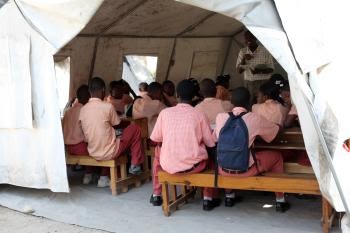
The SOS Herman Gmeiner School in Santo is barely recognisable: instead of classrooms consisting of tents on a dirt floor, brand new hangars now provide ample space for eight classrooms in addition to the existing school building. This significant change for the better was made possible by donations from the German Red Cross and the German embassy.


A fresh start in a brand-new classroom - a first for many of the students. Photo: Sophie Preisch
This past Monday was a big day for many students who attend the SOS Hermann Gmeiner School in Santo: It was their first proper day of school. Not that they didn't have lessons before, it's just that now those lessons are being held in brand new classrooms. On Friday 18 February a new building was inaugurated right next to the existing school, and the tent classrooms could finally be taken down.

The hangars make up eight additional classrooms where 355 students will receive lessons. The building is positioned behind the existing school, which fortunately did not suffer any damage from the earthquake and is still fully operational.

The original school building was not damaged by the earthquake, but the increased number of students made additional space necessary. - Photo: Sophie Preisch 
 Most schools in Haiti are private and often cost more than an average family is able to afford. Especially after the earthquake, when many people lost their homes, the need for free education grew. More than 300 additional children were matriculated in the SOS Hermann Gmeiner School in Santo in order to provide a free education to those who need it. This dramatic increase in the number of pupils of course caused a lack of space where classes could be held. From April 2010, when classes started again after the earthquake, lessons were taught in two shifts, i.e. morning- and afternoon classes and some of them were held in tents.

In Haiti, education is often more costly than average families can afford - free education is practically unheard of. - Photo: Sophie Preisch
 The ground was dusty and classrooms were difficult to keep in order, which made life hard both for childrend and teachers. Now, the space in front of the old school building is cemented and the bright blue hangars at the back side provide a proper space for the classrooms.

The tent classrooms were a good interim solution - but they were dirty, stuffy and hard to keep calm in. - Photo: Sophie Preisch

"The inauguration of this new building is the first step towards a more individual and child-oriented education with fewer students per class", says Max Lamesch, Public Funding Coordinator of SOS Children‘s Villages in Haiti. He also coordinated a cooperation with the German embassy in Haiti, who donated the cost of purchasing individual desk-chairs.

The first few days after the inauguration show a clear difference in the quality of classes. "The classrooms are cooler and the air circulates much better than it did in the tents. Furthermore, the children have more individual space with the new chairs", says a fifth grade teacher.

Donations from the German Red Cross and the German embassy made these improvements possible. - Photo: Sophie Preisch

It is this difference that made the opening of the hangars on Friday such a joyful event. After the inauguration by a priest, the ribbon was cut and the event went on in the community hall of the children's village. SOS Children's Villages also awarded certificates to organizations who had offered their valuable support in order to provide better conditions to SOS students.

Wednesday, 9 February 2011

Happy Birthday Little Star!

Today is a special day for the SOS family in House #8. The table is laden with delicious food and the living room is bursting with guests. Loud music is coming from the speakers as the star of the afternoon makes her appearance: It's Princess Marevie's second birthday.


Marevie is celebrating two birthdays - two years since she was born and one since she was born again. Photo: Sophie Preisch
 Two years might not seem long, but Marevie has a long story. The girl was found a year ago in severe malnutrition. She was cared for by her fathers girlfriend - or rather: was supposed to be cared for by her. The woman, herself a mother, used Marevie to gain access to more food and medicine, but she did not feed her. When SOS co-workers took her to the hospital the day he found her, she hardly had enough strength to keep her eyes open. It took months of treatment to recover, to be able to walk and play.


This SOS co-worker was moved to tears when she saw how healthy Marevie looks compared to one year ago. - Photo: Sophie Preisch 
 Today, that all seems far away, as we watch her dancing in her bright white princess' dress. "She loves to dance", says her SOS mother, "she dances all the time."

Marevie was taken into the SOS Children‘s Village in Santo on 10 February 2010. She has been given an SOS family: a mother, aunties and brothers and sisters who look after her and care for her. They give her love and care and space to develop. During this past year, Marevie has also turned famous, since her story touched many hearts, and still does.

Even though she has become something of a mascot for the whole SOS Children's Village, Marevie seems unaware of all the attention and prefers to play with her SOS sister. - Photo: Sophie Preisch
She herself, seems unaware of all the excitement about her. She surveys her surroundings with a critical expression and prefers playing with her best friend and SOS sister to being the centre of attention. As SOS co-workers are sitting around, eating birthday cake and reflecting how the past year changed this this little girl, Marevie dances away to play with the other kids.

On a bus that never arrived at school

One year ago 33 children were brought to the SOS Children's Village in Santo after a long and sad trip. A group of self-proclaimed missionaries wanted to bring them to the Dominican Republic and were later charged with child trafficking. In March 2010 the children were reunited with their families - we visited two girls and their mother at home to follow up on their story.


In spite of - or because of - her love for her girls, Leila's and Soraja's mother didn't want to pass up an opportunity to offer them a better life abroad. - Photo: Sophie Preisch
 Education is a big issue in Haiti. An estimated 55 percent of Haitians are illiterate, schools are mainly in private hands, and the monthly cost still does not guarantee high-quality education. It was the hope of making a good education available to their children that made 22 parents give away their children one year ago. "Everyone hopes for a good future for their children. They told us they would go to school and we could visit them", says the mother of Leila and Soraja.


On 12 January 2010 their home collapsed and the family - like many others in Haiti - lived in shock and fear. They lost their house and had to sleep outside. It was just two weeks after the earthquake when they were introduced to a group of foreigners who promised a better future for their children. Most of the children, taken from their parents by the ten missionaries came from Calebasse, an area in the mountains outside of Port au Prince. Infrastructure is indeed lacking up here, the dirt roads are full of potholes and there is only one school. Nevertheless, families here live in relatively good conditions, there is a lot of agriculture and the community seems strong.

This is a summary of what happened a year ago: 33 children were brought to the border of the Dominican Republic. There the bus of US-American Missionaries was stopped by Haitian police. The children did not have valid documents - nor an idea of where they were being taken. After a night of debate (and without food for the children) they were finally brought to the SOS Children's Village in Santo, where they were cared for until mid-March. Haitian authorities then decided to reunite all those children - who, contrary to the missionaries' statements, are not orphans - with their families.

"How are the girls?" asks the SOS mother, in whose SOS family house Leila and Soraja lived. "They still call me once in a while. They say: Mama Joseline, we don't have much credit on the phone, but we wanted to say hallo!" Joseline is proud that she was able to ease their difficult time a bit by giving the two of them a temporary home.


Today, the girls are glad to be back home, but still go visit the woman who took them into her family - and call her Mama Joseline. -Photo: Sophie Preisch
 Now, Leila and Soraja are visibly happy to be back at home. They are playing with their cousins, giggling and happily jumping around their mother while she talks to us. "For the next year we hope things will get better. All the things that happened to Haiti, we hope that they do not happen again", she says. The family was able to rebuild their home, they earn some money by offering internet on their computer to neighbours. "Thank god we are fine now. And also for the problem of the school we will find a solution."

Friday, 21 January 2011

A serious man giggles joyfully

Something unexpected happened yesterday: I saw a child become a different child.


Two small boys were sitting outside a house in the SOS Children's Village Santo, eating rice and chatting. As I walked by, the two started waving at me. One of them even got up and ran towards me. Then, all of a sudden, it hit me: that's Sonson!

Sonson and his SOS auntie - Photo: Sophie Preisch
 Running faster than his little legs would allow, the three-year-old fell but immediately got up again and kept running. The other boy came up as well and both of them started talking to me exitedly, but in their own language, which I still don't understand enough to be able to know what they were saying to me. Instead, I tied Sonson's shoelaces as the two of them kept happily giggling and looking at me with their bright eyes. Then they ran back to their plates of rice and sat down again to go on eating as they waved their goodbyes.

This little encounter made my whole day!

I first met Sonson in November as the boy who overcame severe malnutrition and who, to everyone‘s surprise, was getting stronger by the day and walking about just like the other kids. "When the boy was brought here in march 2010, I was sure he would never be able to walk", says a co-worker who saw Sonson when he arrived at the Village in Santo. "He wore a shirt that was way too big for him and his legs looked like strings coming out from under that shirt." The boy was estimated to be about two years old, and was found naked and alone by journalists. Under the care of his SOS mother he grew stronger and stronger. Still, he seemed quite absent-minded when I first visited him.


Saving his smile for other occasions - Sonson is a serious man! - Photo: Sophie Preisch
 Today, Sonson lives with his ten SOS brothers and sisters in an SOS family house. Up until the end of 2010, he still had 17 SOS siblings living with him. Many children then moved to the temporary shelters. Sonson's SOS auntie tells me that she's still kept busy, though, because Sonson demands a lot of attention: "He wants to share everything with us. For instance, he calls me excitedly to tell me when he sees a beetle".

Sonson is watching us shyly when we visit to take some pictures. He is not as chatty as he was with his friend in the garden, but he still seems curious about his visitors. "It's hard to get a smile from him, he's a serious man", says the SOS auntie jokingly - but by now I know that this boy is nowhere near as serious when there are no cameras around.

Wednesday, 12 January 2011

"We will never forget you"

On a white sheet children wrote their thoughts into three columns: one for 12 January 2010, one for 12 January 2011 and one for 12 january 2020. "Everyone was affected" reads the first column, or "We will never forget all those who died". One boy vented his anger about what happened with words that could be translated as "Doomsday for Haiti". One boy recalls, that he missed out on his date for the earthquake. The "today"-column is filled with aspiration and plans, it says things like: "We are working hard today, but we'll be working even harder tomorrow", "We have to unite our forces to make Haiti move on", "We need to get our people out of the tents".
This poster with the handprints of the children reads "Together we are strong!" - Photo: Sophie Preisch

A moment of remembrance
In the morning, schoolchildren from the SOS Hermann Gmeiner School get together to celebrate mass, remembering all those who lost their lives in the earthquake. Hundreds of children sit on wooden benches or plastic chairs in the schoolyard. They are singing, praying and listening. Many of them lost their homes a year ago, many even lost their parents, siblings or other loved ones. The earthquake and all its consequences has become Haiti's reality - but still it seems so far away.
Holy mass was celebrated in remembrance of those whose lives were taken by the earthquake - Photo: Sophie Preisch

After mass and a short performance by the choir of children and youngsters from the children's village, a letter from Helmut Kutin, the President of SOS Children‘s Villages, is read out loud by the interim national director Dionisio Pereira. To co-workers and especially mothers this is an important moment: he sends his appreciation for their commitment and the strength they showed over the past year. The earthquake - as one of the children also wrote on the poster - has affected everyone in Haiti. Those who survived and who were here right after the quake to help others have also had traumatic experiences and had to cope with it.

The SOS mothers had to adapt to an overwhelming situation in very little time - Photo: Sophie Preisch


Hope unites the people

Prior to the celebrations the children had written their wishes and sorrows on little pieces of paper, and a bonfire is lit to transform these messages and help them ascend to heaven to be heard by higher powers. A long line of students walks solemnly past the fire, throwing in their wishes one by one. Some children are clearly enjoying the special event, others seem more pensive and quiet.

While may children clearly enjoyed sending their hopes and fears skywards via bonfire...

In the afternoon, when the children have gone, the village grows quiet once more. Everyone is reflecting on what happened and how to go on. Sometimes it's hard to understand why people are still forced to live in tents and why there are still so many ruins. What is it that makes everything so slow here? What have we learned, what has Haiti learned? What will it take for this country to rediscover its own strength?


Others seemed a bit more quiet and lost in thought - Photos: Sophie Preisch

For many children this date might be an unpleasant memory, but it's probably even harder to really reflect on what happened. The event has brought them together, has given them a moment to remember. And - after all - it's hope that unifies Haiti. As though to illustrate just that point, the 2020-column of the poster says things like: "Children in the future will be born into a better Haiti", "We won't give up". The boy who missed his chance at a date with a special girl last year simply writes "In 2020, my dates will work out".